'/%3e%3c/g%3e%3c/svg%3e)

Best Zoho Mail alternatives in 2026
The best Zoho Mail alternatives in 2026, compared by platform, AI, pricing, strengths, and weaknesses. See how Dove, Canary Mail, Proton Mail, Fastmail, and Google Workspace stack up.

Zoho Mail earned its following the honest way. Cheap business email on your own domain, no ads in the margins, a parent company that makes money selling software instead of attention, and a giant suite of apps sitting behind it for almost anything a small company touches. For clean, affordable, ad-free hosting, it has been a reliable answer for years.
So why are so many Zoho users shopping around in 2026? Usually because the inbox itself has stood still. Zoho Mail will deliver, store, and search your messages without complaint. What it will not do is tell you what changed three replies into a long thread, draft something in your voice, pull action items into a list, separate the urgent from the noise, or flag a phishing attempt before you click. The interface looks its age, the wider suite is a lot to navigate, and support can be slow. Once your volume climbs, that gap stops being theoretical.
This guide ranks the strongest Zoho Mail alternatives by what they actually do, with honest notes on platforms, pricing, and trade-offs. Dove and Canary Mail come first because they are the two products our team builds and knows best. The strongest privacy and business-hosting options follow.
Key takeaways
Dove is the pick if you want the inbox to do the thinking. AI-native sorting into Focus, Noise, and Done, with thread analysis and a daily task list, so the mail that needs you stops getting buried.
Canary Mail is the privacy-first option, a mature encrypted client with optional AI you switch on only when you want it. A natural fit for Zoho users who came for the ad-free, low-noise stance.
Proton Mail goes further on encryption than Zoho Mail and adds a full privacy suite, but it does not solve triage or add meaningful AI.
Fastmail is the fast, standards-based host for people who only ever wanted reliable IMAP email without a suite wrapped around it.
Google Workspace and Microsoft 365 are the mainstream business suites Zoho undercuts. Strong on collaboration, light on real inbox intelligence.
What to look for in a Zoho Mail alternative
Start with what Zoho Mail is and is not. It is a capable, low-cost business email host with custom domains and a deep app suite behind it. What it does not do is think about your mail for you. Once a message lands, the sorting, the summarizing, and the deciding are all on you.
A strong alternative should improve on at least one of these:
Triage that decides, not just delivers. Filing mail into folders is not the same as telling you what needs a reply today.
Help inside the message. Long threads hide changed terms, deadlines, and action items. A good tool surfaces them instead of making you reread.
Real platform coverage. You read email on a phone and a laptop, so the experience should follow you with genuine native apps, not just a browser tab.
Security, not just storage. Phishing and impersonation belong out of your way automatically, with a clear risk signal.
Privacy and value you can verify. If you left Gmail for an ad-free, independent host, encryption, ownership, and honest pricing still matter.
With that frame, here is how the top alternatives compare.
Quick comparison
The table below is the fast version. Each tool is covered in detail further down, including what it does well and where it falls short.
Email app | Platforms | AI approach | Starting price | What it does well | Where it falls short |
|---|---|---|---|---|---|
iOS, Android, macOS, Windows, Web | AI-native, triage is the foundation | Free plan (10 AI actions/day); Pro $20/month, 7-day trial | Automatic Focus, Noise, and Done triage, thread intelligence, task extraction, security scoring | Newest name here, smaller third-party integration list today | |
iOS, macOS, Android, Windows | Optional AI, Copilot is opt-in | Free tier (no AI); Growth $36/year, Pro+ $100/year | Privacy-first, PGP encryption, mature client, AI you can leave off | AI is an add-on, not the core; feature-dense for new users | |
Proton Mail | Web, iOS, Android, macOS, Windows, Linux | Limited, optional writing assistant | Free (1GB); Mail Plus ~$3.99/month; Unlimited ~$9.99/month | End-to-end encryption, Swiss privacy, full app lineup | Needs Bridge for IMAP desktop clients; AI help is minimal |
Fastmail | Web, iOS, Android (desktop via IMAP only) | No AI | Individual ~$6/month, 60GB | Fast, reliable, independent, great IMAP and Masked Email | No real triage, no AI, no dedicated desktop app |
Google Workspace | Web, iOS, Android, desktop via browser | Gemini add-on, optional | Business Starter ~$7.20/user/month | Mature collaboration suite, deep integrations, reliable | AI costs extra, inbox is still manual triage, you are in Google’s ecosystem |
Zoho Mail | Web, iOS, Android, macOS, Windows | Minimal, optional Zia assist | Mail Lite ~$1/user/month; free for one domain | Cheap, ad-free, custom domains, huge app suite | No real triage or thread AI, dated interface, sprawling suite |
Pricing is approximate and changes often, so check each provider for current rates before you commit.
1. Dove
Dove is an AI-native email app, and it is the sharpest break from the Zoho Mail model. Where Zoho gives you a cheap, ad-free place to keep business mail, Dove reads and sorts that mail for you. The AI is the foundation here, not a feature bolted on once the rest of the product was finished.
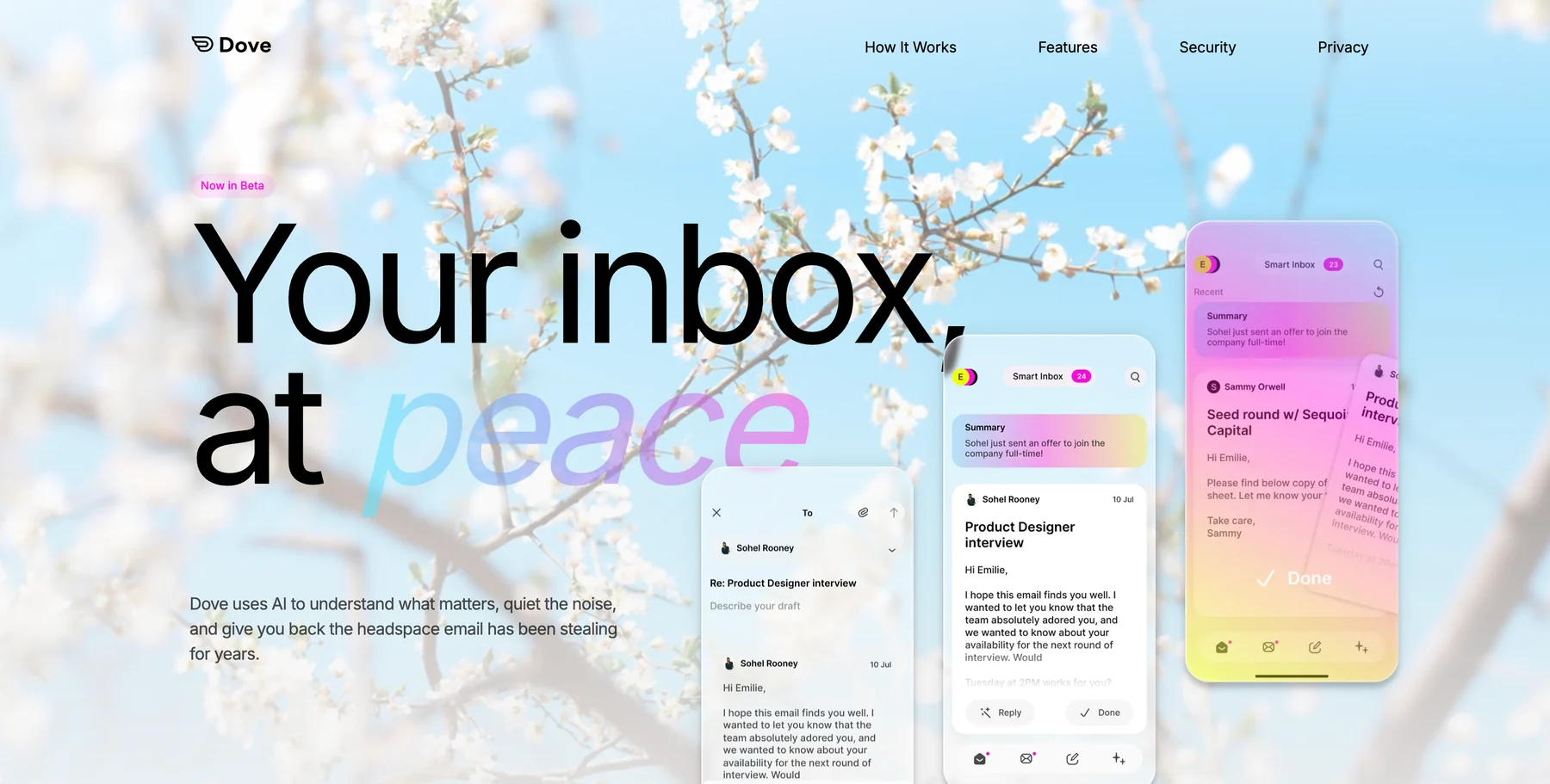
Every incoming message lands in one of three states: Focus (needs you), Noise (does not need you), or Done (already handled). There is no “maybe later” pile to babysit. Open a Focus email and Wingman reads the whole thread and points out risks, gaps, changed terms, and overdue items before you reply. AI Assist lets you talk to your inbox in plain language to search, archive, label, and draft. Every morning, Daily Tasks turns your Focus mail into a ranked to-do list, and Dove’s security scoring quarantines dangerous mail before it reaches you.
For a deeper look at how this style of sorting works, see our guide to the email triage system.
Platforms: iOS, Android, macOS, Windows, and Web, with server-side classification that syncs everywhere instantly. The desktop experience is a real native app, and Dove connects on top of Gmail, Microsoft, and IMAP accounts, so you can keep a Zoho-hosted domain and still get the AI layer.
What it does well: Automatic triage that actually decides, thread intelligence through Wingman, task extraction, built-in security scoring, and a calm interface designed to reduce inbox dread.
Where it falls short: Dove is the newest name on this list, so it connects to fewer third-party tools today, and it is not built to be the host of record the way a full business suite is. A handful of classic power-user shortcuts are still being added.
Pricing: A free plan covers core inbox features with up to 10 AI actions per day across unlimited accounts. Pro is $20/month with a 7-day free trial, and unlocks unlimited AI with no credits or caps, daily tasks, meeting detection, and one inbox for Gmail, Microsoft, and IMAP across Mac, iOS, Windows, Android, and Web.
Best for: People who want AI to carry the cognitive load of email, not just store it cheaply.
Try Dove on the inbox you already use.
2. Canary Mail
Canary Mail is the mature, privacy-first sibling to Dove, built by the same team. If your reason for choosing Zoho Mail was an ad-free, privacy-minded inbox, Canary Mail is the most natural move. It is a full traditional email client with strong encryption, and its AI stays completely optional.
The Copilot AI is genuinely opt-in. Run Canary Mail as a fast, private, encrypted client with no AI in the loop at all, and flip on AI assist for drafting or summaries only when it earns its place. That suits people who liked Zoho’s restraint on ads and tracking but want deeper power-user tools, with AI strictly on their own terms.
Platforms: iOS, macOS, Android, and Windows, with native apps rather than a web-only desktop experience. It connects to any IMAP account, so a Zoho-hosted domain works fine.
What it does well: Privacy-first design with PGP encryption, HIPAA-compliant SecureSend, on-device processing, read receipts, snooze, templates, and a deep set of power-user tools. It is battle-tested with more than 2 million users.
Where it falls short: Because the AI is optional and added on top, it is not the organizing principle the way it is in Dove. The feature set can also feel dense if you only want a simple inbox.
Pricing: A free tier with no AI. Paid plans are Growth at $36/year (about $3/month) and Pro+ at $100/year, with lifetime options. The AI Copilot lives in the paid tiers, so you only pay for AI if you actually want it.
Best for: Privacy-conscious Zoho Mail users who want a proven, encrypted client with optional, on-demand AI.
3. Proton Mail
If your move away from Zoho Mail is really about pushing privacy further, Proton Mail is the obvious pick. It is a Swiss, end-to-end encrypted service with a full lineup of apps, and it folds into a wider suite of VPN, calendar, drive, and password tools when you want them. That makes it a natural rival to Zoho’s all-in-one pitch.
Platforms: Web, iOS, Android, and desktop apps for macOS, Windows, and Linux. Connecting a standard desktop mail client over IMAP requires Proton Mail Bridge, which is a paid-tier feature.
What it does well: Genuine end-to-end encryption, a strong privacy track record, a clean modern interface, custom domain support on paid plans, and a broad app ecosystem under one account.
Where it falls short: The encryption model means standard IMAP access goes through the Bridge, which is less seamless than Zoho’s open approach. Its AI help is minimal, currently limited to an optional writing assistant, so it does not solve the triage or thread-intelligence problem.
Pricing: A free plan includes 1GB. Mail Plus is around $3.99/month and Proton Unlimited is around $9.99/month billed annually, with business and family plans available.
Best for: People whose top priority is encrypted, independent email and who want a whole privacy suite, not AI.
4. Fastmail
Fastmail is the choice for people who liked Zoho Mail’s reliability and value but never wanted the rest of a suite weighing them down. It is fast, private, independent, and built around open standards, so it works well with any IMAP or JMAP client.
Platforms: Web and native iOS and Android apps. On the desktop there is no dedicated app, so you use the web or connect Fastmail to a client like Apple Mail or Outlook over IMAP.
What it does well: Fast, dependable hosting, real privacy without lock-in, excellent support for standard protocols, custom domains, and Masked Email for throwaway addresses.
Where it falls short: It delivers and stores, and that is essentially the whole job. No triage, no thread intelligence, no drafting, no task extraction, no security scoring, no native desktop app. Everything past “your mail arrived” is on you.
Pricing: The Individual plan is around $6/month (cheaper billed annually) with 60GB of storage, plus Duo and Family plans for more people.
Best for: People who want fast, private, standards-based email and do not need an app suite around it.
5. Google Workspace
If your Zoho Mail setup was really about running a small business on custom domains, Google Workspace is the mainstream version of that idea. It pairs Gmail with Docs, Sheets, Meet, Drive, and the rest, and most clients and partners already live inside it, so collaboration friction is low.
Platforms: Web, iOS, and Android, with desktop access through the browser or by connecting Gmail to a client over IMAP.
What it does well: A mature, reliable collaboration suite, deep third-party integrations, excellent spam filtering, and near-universal familiarity for teams and the people they email.
Where it falls short: The core inbox is still manual triage. Labels and filters do the sorting, you do the deciding. Real AI lives in the Gemini add-on, which costs extra, and you are committing further to Google’s ecosystem, which is the opposite of why many people chose Zoho in the first place.
Pricing: Business Starter is around $7.20/user/month, with Standard and Plus tiers above it, billed per user.
Best for: Small teams that want a proven, collaboration-first suite and do not mind living inside Google.
6. Zoho Mail itself (and when to keep it)
It is fair to ask whether you should switch at all. If your inbox is calm, your costs matter more than inbox intelligence, you value the ad-free stance, and you already use other Zoho apps, Zoho Mail still earns its keep. Its custom-domain support is solid, the free tier for a single domain is genuinely useful, and the per-user pricing undercuts almost everyone.
Platforms: Web and native apps for iOS, Android, macOS, and Windows.
What it does well: Very low cost, no ads, custom domains, generous storage for the price, and tight integration with the broader Zoho suite for teams already invested in it.
Where it falls short: It delivers and stores well, but the inbox stays manual. The Zia assistant is minimal, there is no automatic triage, no real thread intelligence, and no task extraction. The interface feels dated next to newer clients, and the sheer size of the suite can be overwhelming.
Pricing: Mail Lite starts around $1/user/month, with a free plan for a single domain and a handful of users, plus Workplace bundles that add the rest of the suite.
Best for: Cost-sensitive teams that want cheap, ad-free, custom-domain email and do not want software making decisions about their mail.
How to choose
If you want the inbox to think for you, move to an AI-native client like Dove and let triage, thread intelligence, and task extraction replace the manual sorting habit. You can keep your Zoho-hosted domain and add Dove on top. For more options in that category, see our roundup of the best AI email apps, and if sheer volume is your problem, our guide on how to manage too many emails goes deeper.
If privacy is your first priority but you still want a modern client and optional AI, Canary Mail is the strongest fit. If you want maximum encryption with a full suite, Proton Mail delivers. If you only ever wanted fast, standards-based hosting, Fastmail is hard to beat. If collaboration with a mainstream suite matters most, Google Workspace is the familiar pick. And if cost and the ad-free stance were the whole appeal, Zoho Mail was never broken, so keeping it is a perfectly reasonable answer.
Frequently asked questions
What is the best Zoho Mail alternative in 2026?
For most people who want more than cheap, ad-free hosting, Dove is the strongest alternative because it is AI-native. It triages every message into Focus, Noise, or Done, reads threads for you, and extracts tasks automatically. If privacy and a proven client matter most, Canary Mail is the better fit, with optional AI you turn on only when you want it.
Why would I switch away from Zoho Mail?
Zoho Mail is excellent at low-cost, ad-free hosting on custom domains, but the inbox itself stays manual. There is no automatic triage, no real thread intelligence, no task extraction, and only a minimal AI assistant. People usually switch when they want the inbox to help decide what needs a reply, summarize long threads, draft messages, or build a task list, or when the dated interface starts to slow them down.
Can I keep my Zoho domain and still use Dove?
Yes. Dove connects on top of Gmail, Microsoft, and standard IMAP accounts, so you can keep email hosted on your Zoho custom domain and still get Dove’s AI triage, thread intelligence, and daily tasks layered over it across Mac, iOS, Windows, Android, and Web.
Does Dove cost anything?
Dove has a free plan with core inbox features and up to 10 AI actions per day across unlimited accounts. Pro is $20/month with a 7-day free trial, and unlocks unlimited AI, daily tasks, security scoring, and sync across iOS, Android, macOS, Windows, and Web.
Is Canary Mail’s AI required to use it?
No. Canary Mail’s Copilot AI is optional. You can use Canary Mail as a fast, encrypted, privacy-first client with no AI in the loop, then enable AI assist for drafting or summaries only when it is useful. The AI lives in the paid tiers, so you only pay for it if you want it.
Which Zoho Mail alternative is cheapest?
Zoho Mail itself remains one of the cheapest options, starting around $1/user/month with a free single-domain tier. Among the alternatives, Fastmail and Proton Mail’s lower tiers are affordable, and Dove’s free plan lets you add AI triage at no cost up to 10 AI actions per day before you decide whether Pro is worth it.
Bottom line
Zoho Mail does one job well: cheap, ad-free, custom-domain hosting with a whole app suite behind it. If that is all you ever wanted, it is still hard to beat on price. The moment you want the inbox to actually help, its manual approach starts to show. Dove is the cleanest upgrade, triaging every message into Focus, Noise, and Done, reading long threads, and pulling out tasks so nothing important slips, and it can sit right on top of your existing Zoho domain. Canary Mail covers the same ground when privacy comes first, with optional AI you turn on only when you want it. Proton Mail and Fastmail handle encrypted and standards-based hosting respectively, and Google Workspace is there if a mainstream collaboration suite matters most.
Try Dove free, it works on top of your existing email and takes about two minutes to connect.
More from Dove
Recent posts

June 25, 2026
Best Proton Mail alternatives in 2026
The best Proton Mail alternatives in 2026, compared by platform, AI, pricing, strengths, and weaknesses. See how Dove, Canary Mail, Tuta, and Fastmail stack up.

June 24, 2026
Best Email Apps for Remote Workers in 2026
The best email apps for remote workers in 2026, compared by platform, AI, pricing, and how well they handle async communication. Dove, Canary Mail, Outlook, Spark, and Missive reviewed.

June 23, 2026
Best Fastmail alternatives in 2026
The best Fastmail alternatives in 2026, compared by platform, AI, pricing, strengths, and weaknesses. See how Dove, Canary Mail, Proton Mail, and Tuta stack up.