'/%3e%3c/g%3e%3c/svg%3e)

Best Email Apps for Teachers in 2026
The best email apps for teachers in 2026, compared by platform, AI, pricing, strengths, and weaknesses. See how Dove, Gmail, Outlook, and Spark stack up for the classroom inbox.

A teacher’s inbox is its own category of chaos. Parent questions, student submissions, late-work excuses, district announcements, grade-portal alerts, IEP threads, club logistics, and the daily drip of edtech newsletters all land in the same place. Miss one message and it can mean a missed deadline, a frustrated parent, or a student who needed help and did not hear back.
Volume is only part of it. The harder problem is that almost nothing arrives sorted by what actually needs you. Schools are also a favorite phishing target: fake payroll notices and spoofed admin requests land right next to the real ones. So the right email app is not about a prettier interface. It needs to surface what matters, pull out the deadline buried in a long thread, handle multiple accounts without making you switch apps constantly, and flag the scam before you click it.
This guide covers the best email apps for teachers in 2026 with honest notes on platform support, pricing, and trade-offs. Dove and then we get to the tools most schools already run.
Key takeaways
Dove is the pick if you want the inbox to do the deciding: AI-native triage into Focus, Noise, and Done, with thread analysis and task extraction so deadlines stop slipping.
Gmail and Outlook are what most districts already provide, reliable but noisy, with no real triage out of the box.
Spark is a friendly middle ground with a free tier and a clean inbox.
Match the app to your actual problem: deciding what needs a reply is a different job from simply storing mail.
What teachers should look for in an email app
Before the list, it helps to be clear about what a school inbox actually demands. You do not need enterprise sales features. You need fewer decisions, fewer missed deadlines, and less end-of-day dread.
A strong pick should handle most of these:
Triage that decides, not just files. Moving mail into a folder is not the same as telling you which parent email needs a reply tonight.
Deadline and task rescue. Due dates and action items hide inside long threads. A good app pulls them out.
Multiple accounts in one place. Most teachers run a school account and a personal one, and switching apps throughout the day adds unnecessary friction.
Security that protects you. Phishing aimed at school staff should be flagged or quarantined before it reaches you.
Calm by design. The inbox should reduce stress during the school year, not contribute to it.
With that in mind, here are the apps worth your time.
Best email apps for teachers at a glance
The table below is the fast version. Each tool is covered in detail underneath.
Email app | Platforms | AI approach | Starting price | What it does well | Where it falls short |
|---|---|---|---|---|---|
iOS, Android, macOS, Windows, Web | AI-native, triage is the foundation | Free plan (10 AI actions/day); Pro $20/month, 7-day trial | Sorts mail into Focus, Noise, and Done automatically, reads threads, extracts deadlines, scores messages for phishing | Newer app, smaller third-party integration list today | |
Gmail (Google Workspace) | Web, iOS, Android (desktop via browser) | Light AI in paid Workspace tiers | Free personal; Education Fundamentals free for schools | Familiar, reliable, huge ecosystem, standard in Google districts | Noisy by default, no real triage, weak native phishing warnings |
Outlook (Microsoft 365) | Windows, macOS, iOS, Android, Web | Copilot AI on paid Microsoft 365 | Free personal account; M365 Education often provided by schools | Calendar and Teams integration, mature security, standard in Microsoft districts | Cluttered UI, Focused Inbox misses often without training |
Spark | iOS, macOS, Android, Windows, Web | Optional AI assist | Free tier; Premium from about $8/month | Clean inbox, smart prioritization, send later, snooze | Triage is lighter than Dove; some features behind Premium |
Pricing is approximate and changes often, so check each provider for current rates before you commit.
1. Dove
Dove is an AI-native email app, which turns out to be the cleanest match for a teacher whose inbox is always at capacity. The AI is not a feature bolted on later. It is the organizing principle, and it is aimed at the specific problem most apps ignore: figuring out what actually needs a reply and what does not.
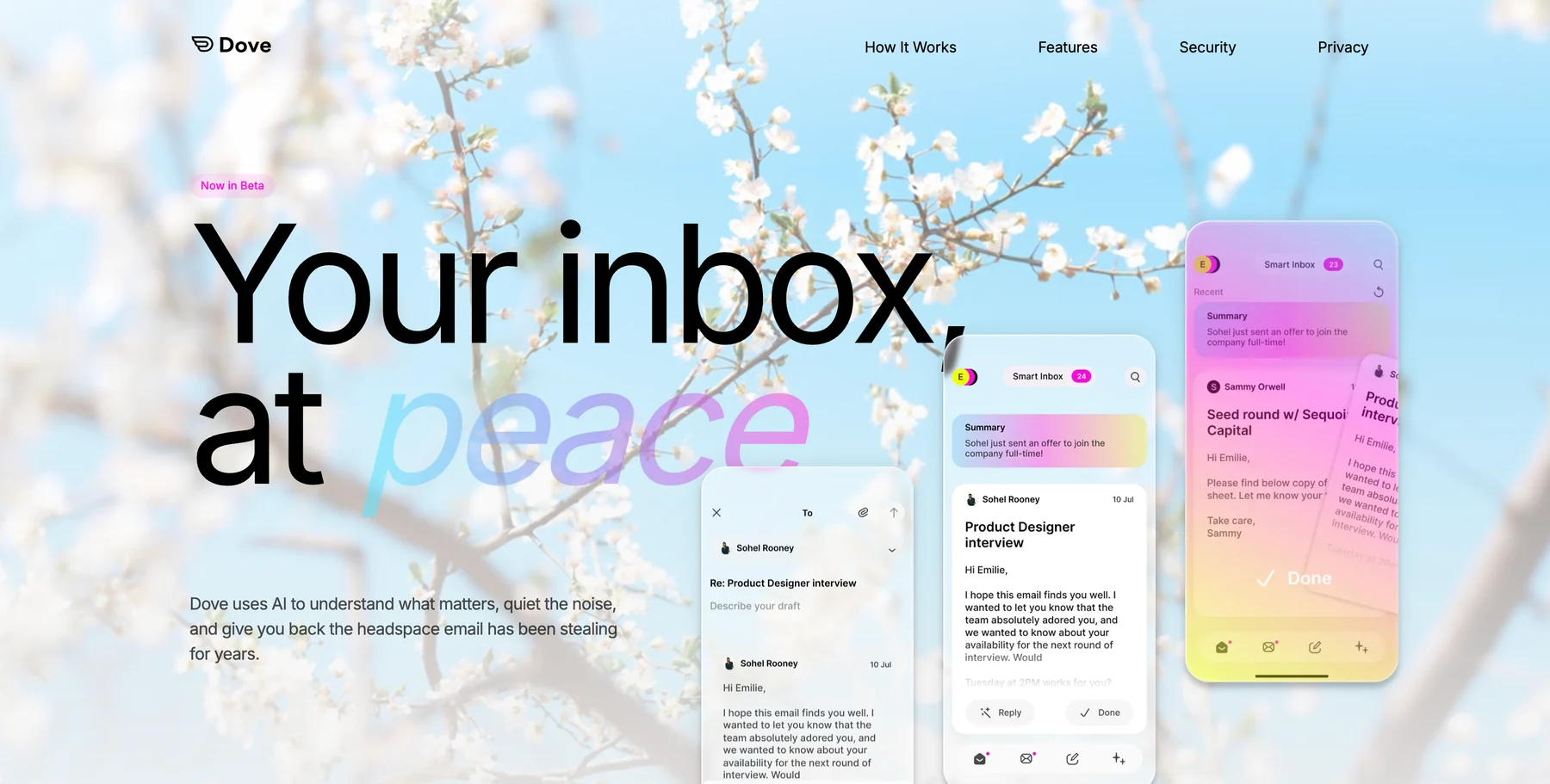
Every incoming message is sorted into one of three states. Focus is mail that needs you, a parent question, a principal’s request, a time-sensitive ask. Noise is everything that does not. Done is mail already handled. When you open a Focus email, Wingman reads the full thread and surfaces the buried deadline, the unanswered question, or the changed meeting time before you start typing. AI Assist lets you search, archive, label, and draft in plain language. Each morning, Daily Tasks turns your Focus mail into a ranked list of what to handle. Dove’s security scoring pulls phishing messages out before they reach you.
For a closer look at how this kind of sorting works in practice, see our guide to the email triage system.
Platforms: iOS, Android, macOS, Windows, and Web, with server-side classification that syncs everywhere instantly.
What it does well: Automatic triage that actually decides, thread intelligence through Wingman, deadline and task extraction, built-in phishing protection, and an interface that makes the inbox feel less like a second job. It works on top of your existing school Gmail or Microsoft account, so there is no migration headache.
Where it falls short: Dove is the newest name here and connects to fewer third-party tools today, so it is not yet wired into gradebooks or learning management platforms. Some traditional power-user shortcuts are still being added.
Pricing: A free plan covers core inbox features with 10 AI actions per day across unlimited accounts. The Pro plan is $20/month with a 7-day free trial and unlocks unlimited AI, daily tasks, meeting detection, and a unified inbox across Gmail, Microsoft, and IMAP.
Best for: Teachers who want the app to carry the cognitive load of triage rather than hand it back to them in a different shape.
Try Dove free, it works on top of your existing school email and takes about two minutes to connect.
2. Gmail (Google Workspace for Education)
If your school runs Google, Gmail is already in your hands, and there is a real case for staying put. It is reliable, searchable, and connected to Classroom, Drive, and everything else your district depends on. Education Fundamentals is free for qualifying schools.
Platforms: Web, iOS, and Android, with desktop access through the browser.
What it does well: Rock-solid reliability, strong search, a massive ecosystem, and tight integration with Google Classroom and Drive. Most Google districts manage it centrally, so you do not have to think about setup.
Where it falls short: Gmail stores and labels mail, but it does not triage. Important parent messages sit next to promotions, the built-in categories miss regularly, and native phishing warnings are not built for targeted attacks on school staff.
Pricing: Free for personal accounts. Schools typically get Google Workspace for Education Fundamentals at no cost, with paid upgrades for more storage and security.
Best for: Teachers in Google districts who want the familiar default and are not looking to change clients.
3. Outlook (Microsoft 365 for Education)
If your school runs Microsoft, Outlook is the equivalent standard. It pairs email with a strong calendar, Teams, and the Office apps, and many districts provide Microsoft 365 Education licenses for staff. For teachers who live in Teams meetings and shared documents, the integration is genuinely useful.
Platforms: Windows, macOS, iOS, Android, and Web.
What it does well: A mature calendar, Teams and SharePoint integration, solid rules and automation, and enterprise-grade security and compliance that districts trust.
Where it falls short: The interface is cluttered by default, and Focused Inbox guesses wrong without training. Copilot AI sits behind paid Microsoft 365 tiers, and like Gmail it sorts more than it decides.
Pricing: Free for personal accounts. Microsoft 365 Education licenses are commonly provided by schools, with paid Microsoft 365 plans starting around $6 per user per month for non-school use.
Best for: Teachers in Microsoft districts who rely on Teams, the Office apps, and a strong calendar.
4. Spark
Spark is the friendly middle ground. It offers a clean modern inbox with smart prioritization, snooze, scheduled send, and a useful free tier, without the setup overhead of a heavier tool. If you want a calmer inbox without committing to an AI-native client, it is an easy starting point.
Platforms: iOS, macOS, Android, Windows, and Web.
What it does well: A genuinely useful free tier, a tidy interface, smart inbox prioritization, and quality-of-life features like snooze and scheduled send. Optional AI assist helps with drafting and summaries.
Where it falls short: Its prioritization is lighter than Dove’s full triage, it will not extract deadlines from threads, and some features sit behind Premium.
Pricing: Free tier for individuals. Premium starts at roughly $8 per month, with discounts for annual billing.
Best for: Teachers who want a cleaner inbox and better scheduling features without moving to a fully AI-native client.
How to choose
Start with your actual problem. If you spend too long deciding what needs a reply and deadlines keep slipping anyway, the default school client is not going to fix that. Move to an AI-native app like Dove and let triage, thread intelligence, and task extraction do the deciding for you, on top of the school account you already have. For more options in that category, see our roundup of the best AI email apps, and if sheer volume is the issue, how to manage too many emails goes deeper.
If your first concern is privacy around student and family information If you are happy inside your district’s Google or Microsoft setup, Gmail and Outlook work fine, you just do the sorting yourself. Spark sits in between for a cleaner inbox without the full switch.
FAQ
What is the best email app for teachers in 2026?
For most teachers who want fewer decisions and fewer missed deadlines, Dove is the strongest pick because it is AI-native: it triages every message into Focus, Noise, or Done, reads threads to surface buried deadlines, and builds a daily task list automatically. If privacy around sensitive correspondence matters most with optional AI you turn on only when you want it.
Can I use these apps with my school Gmail or Outlook account?
Yes. Dove works on top of your existing Gmail, Microsoft, or IMAP account, so you keep your school address and get AI triage on top. Spark and . There is no migration and no change to your school email address.
Does Dove cost anything?
Dove has a free plan with core inbox features and 10 AI actions per day across unlimited accounts, so you can start at no cost. The Pro plan is $20/month with a 7-day free trial and unlocks unlimited AI, daily tasks, phishing protection, and sync across every device.
How do these apps help with phishing aimed at schools?
Schools are a common phishing target, with fake payroll and admin notices landing in staff inboxes regularly. Dove scores incoming mail for risk and quarantines dangerous messages before they reach you. . Gmail and Outlook include general spam filtering, but their warnings are weaker against targeted attacks on school staff specifically.
Which email app is best for managing both a school and a personal account?
Dove is built to hold multiple accounts in one inbox and triages them together across Gmail, Microsoft, and IMAP, so you stop switching apps throughout the day. Spark also supports multiple accounts in a unified inbox, while Gmail and Outlook keep accounts more separate unless you configure forwarding.
Bottom line
If your inbox runs your day, stop sorting it by hand. Dove triages every message, reads the long threads, and pulls out the deadlines so a parent reply or a principal’s request never slips. with AI you turn on only when you want it. Gmail and Outlook are perfectly fine if you are happy doing the sorting yourself, and Spark is the gentle upgrade in between.
Try Dove free, it works on top of your existing school email and takes about two minutes to connect.
More from Dove
Recent posts

September 16, 2026
Dove vs Superhuman: Two Answers to the Same Inbox
Superhuman makes you faster at email. Dove does more of the email for you. Compare AI triage, platforms, providers and plans to find your fit.
August 17, 2026
Best Email App for Multiple Accounts in 2026
Juggling more than one inbox? Here is the best email app for multiple accounts in 2026, plus two other ways to fix inbox overwhelm for good.
July 1, 2026
Best Airmail Alternatives in 2026
The best Airmail alternatives in 2026 compared. See platform support, pricing, strengths, and weaknesses for Dove, Canary Mail, Spark Mail, Mimestream, Edison Mail, Shortwave, Outlook, and Apple Mail.