

Proton Mail Pricing (2026): Every Plan, What It Really Costs, and Whether It's Worth It
Proton Mail has a free plan. Its main paid plan, Mail Plus, costs $4.99 a month, or $47.88 a year ($3.99 a month). Proton Unlimited, which adds Proton's VPN, password manager and 500 GB of storage, costs $12.99 a month or $119.88 a year ($9.99 a month). Duo for two people is $19.99 a month, and Family for six is $29.99 a month. Business plans start at $6.99 per user a month, billed yearly.
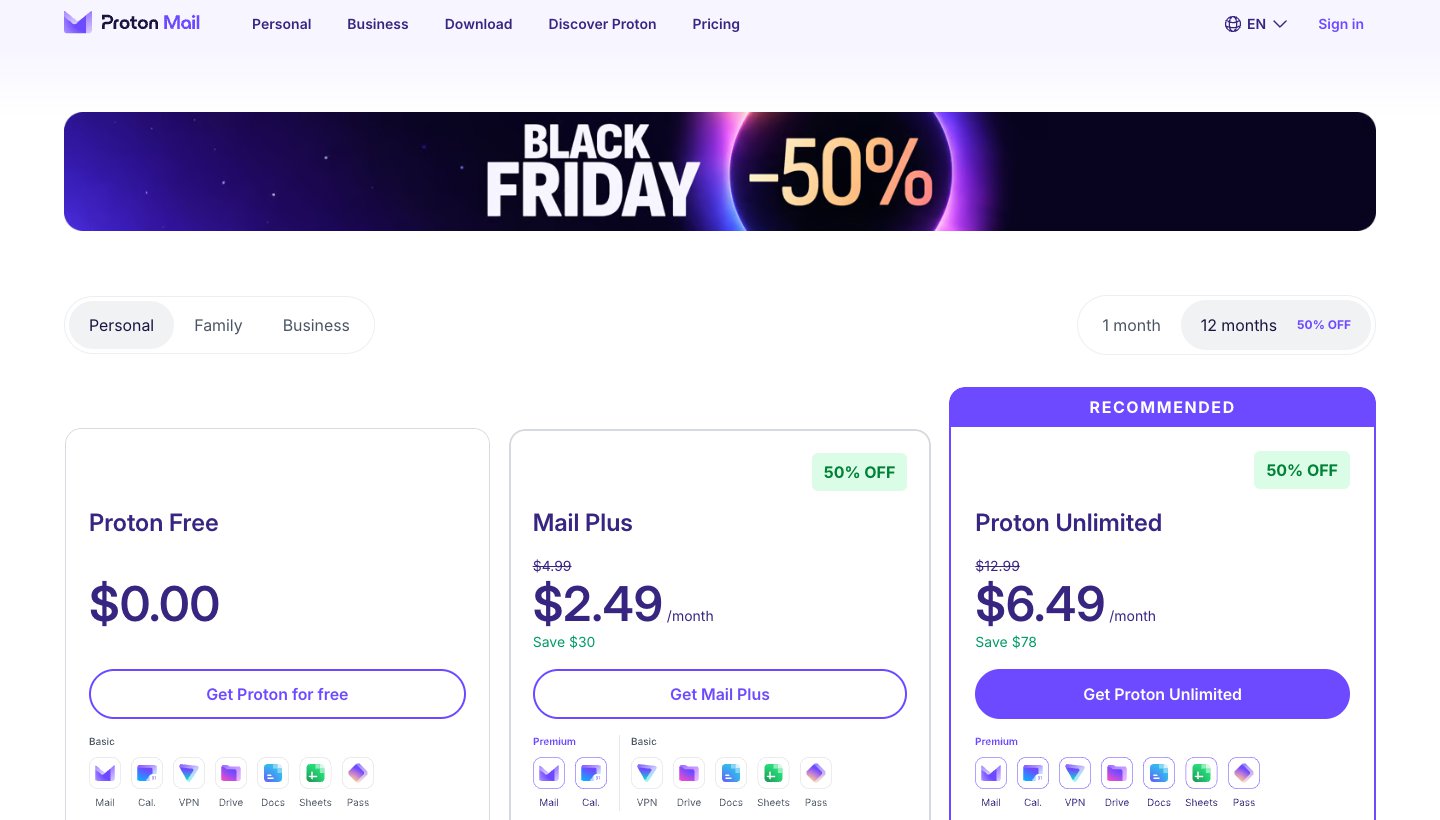
As of November 19, 2026, Proton is running a Black Friday sale, so you'll see lower prices on its site: Mail Plus at $2.49 a month and Unlimited at $6.49 a month, billed yearly. Those prices are for the first year only. After that, Proton says the plan "renews at" the regular price above.
Disclosure: We make Dove, an email app, and Dove is made by the team behind Canary Mail. Dove doesn't compete with Proton as an email provider, and Dove doesn't have end-to-end encryption. Every price below comes from proton.me, checked in US dollars on November 19, 2026.
Proton Mail plans and prices at a glance
Plan | Monthly | Yearly (regular) | Black Friday, first year | For |
|---|---|---|---|---|
Proton Free | $0 | $0 | Not on sale | Trying Proton, light use |
Mail Plus | $4.99 | $47.88 ($3.99/mo) | $29.88 ($2.49/mo) | One person who wants private email |
Proton Unlimited | $12.99 | $119.88 ($9.99/mo) | $77.88 ($6.49/mo) | One person who wants Proton's VPN, Pass and Drive too |
Proton Duo | $19.99 | $179.88 ($14.99/mo) | No sale price | Two people |
Proton Family | $29.99 | $287.88 ($23.99/mo) | No sale price | Up to six people |
Mail Essentials (business) | $7.99 per user | $83.88 per user ($6.99/mo) | No sale price | Small teams that need email only |
Workspace Standard (business) | $14.99 per user | $155.88 per user ($12.99/mo) | $107.88 per user ($8.99/mo) | Teams that want email, Drive, VPN, Pass and video calls |
Workspace Premium (business) | $24.99 per user | $239.88 per user ($19.99/mo) | $179.88 per user ($14.99/mo) | Larger needs: 3 TB per user, Proton's AI tools included |
Prices are from Proton's Mail pricing page and its business pricing page. Proton offers 1-month and 12-month billing; we found no 24-month option on its pricing pages today. The monthly per-month figures for yearly plans are the yearly price divided by 12.
Black Friday prices vs regular prices
This is where Proton price lists often go wrong. Google's own AI summary, for one, mixes the two.
Mail Plus, yearly: $29.88 for the first year during the sale, "then renews at $47.88 every 12 months."
Proton Unlimited, yearly: $77.88 for the first year, then $119.88.
Proton Unlimited, monthly: Proton also shows a "welcome" price of $1.00 for the first month, then $12.99 a month.
Workspace Standard and Premium: 40% off the first year for new businesses with up to 10 users. Proton says this business offer ends on November 30, 2026.
Proton's Black Friday page says the sale is for new users and that your plan "will renew automatically every billing cycle at the standard price unless canceled." We found no end date for the personal-plan sale on Proton's pages.
What "50% off" means: Proton measures the discount against paying monthly ($4.99 × 12). Against the regular yearly price of $47.88, the sale price of $29.88 is about 38% off. So if you were going to pay for a year of Mail Plus anyway, the sale saves you $18 in year one. Budget for $47.88 a year after that.
Proton Free: what you get, and the limits
Proton's free plan is real, not a short trial, and it has the same encryption as the paid plans. The limits are what push people to pay:
Storage: 500 MB of mail storage, which Proton raises to 1 GB once you complete its set-up steps. Drive storage is separate.
Sending: 150 messages a day.
Organizing: 3 folders, 3 labels and 1 filter.
One address, and no custom domain.
No other email apps. Using Proton in Outlook, Apple Mail or Thunderbird needs Proton Mail Bridge, and Proton says Bridge "is available only with a paid plan".
Desktop app: a 14-day free trial only.
No auto-reply, auto-forwarding, scheduled send or snooze.
These come from Proton's plans explained page and the comparison table on its pricing page. 1 GB fills up quickly if you keep attachments, which is usually the first reason people upgrade.
Mail Plus: the plan most people need
Price: $4.99 a month, or $47.88 a year.
Storage: 15 GB.
Addresses: 10, plus 1 custom domain (name@yourdomain.com) and 10 hide-my-email aliases.
Unlimited folders, labels, filters and messages per day.
Proton Mail Bridge, so you can use Proton in Outlook, Apple Mail or Thunderbird on a computer.
The desktop app for Mac, Windows and Linux (Linux is in beta).
Not included: Proton Sentinel, its extra account protection. The full VPN, Pass and Drive come with Unlimited.
If you only want private email, this is the plan.
Proton Unlimited: email plus Proton's other apps
Price: $12.99 a month, or $119.88 a year.
Storage: 500 GB, shared across Mail, Drive and Proton's other apps.
Addresses: 15 extra addresses, 3 custom domains and unlimited hide-my-email aliases.
Includes Proton VPN, Proton Pass (password manager), Proton Drive and Proton Sentinel.
Unlimited makes sense if you'd otherwise pay for a VPN and a password manager. If you only want email, Mail Plus is $72 a year cheaper at regular prices.
Duo, Family and Visionary
Proton Duo is for two people: $19.99 a month or $179.88 a year, with 2 TB of storage, 30 addresses and 3 custom domains, and Proton Scribe, its AI writing assistant, included.
Proton Family covers up to six people: $29.99 a month or $287.88 a year, with 3 TB and 90 addresses.
Proton Visionary is a plan for early supporters with six users and 8 TB. Proton lists it only in euros (€39.99 a month or €359.88 a year) on its plans page, not on the pricing page.
Proton Mail for business
Proton's business plans have new names. The current ones, on its business pricing page, are:
Mail Essentials: $6.99 per user a month billed yearly, or $7.99 monthly. 15 GB per user and custom domains.
Workspace Standard: $12.99 per user a month billed yearly ($155.88), or $14.99 monthly. 1 TB per user, plus Drive, VPN, Pass and Meet.
Workspace Premium: $19.99 per user a month billed yearly ($239.88), or $24.99 monthly. 3 TB per user, with Proton's AI tools included.
Every business plan has a 14-day free trial and works with Outlook, Thunderbird and Apple Mail. Older lists still mention "Mail Professional" and "Business Suite"; Proton now calls Mail Professional a legacy plan.
Refunds and payment
30-day money-back guarantee. Proton's terms say you can cancel "within 30 days of the initial purchase and receive a full refund". Cash and bank transfers can't be refunded, and you can only ask for a refund once.
Payment: cards, PayPal and Proton gift cards, plus cash, bank transfer or Bitcoin once you have an account.
Auto-renew: plans bought on proton.me renew automatically.
On iPhone, Proton says it "may apply a surcharge to cover Apple's in-app fees", so paying on the web can be cheaper.
What you're paying for: Proton's encryption, in its own words
Proton is a privacy pick, and that's the honest reason to pay for it. In Proton's encryption guide:
Between Proton addresses, "Messages in transit are always end-to-end encrypted."
To Gmail, Outlook and others, mail is encrypted with TLS on the way, but "Once the email reaches your recipient, it isn't end-to-end encrypted by default." Password-protected emails fix that for one message, on every plan including Free.
Stored mail: "All messages in your Proton Mail inbox are stored with zero-access encryption," which Proton says means "not even Proton" can read them.
Subject lines are not end-to-end encrypted. Proton says this is to stay compatible with email standards.
So Proton protects what's stored in your inbox from Proton itself, and fully encrypts mail between Proton users. It can't make Gmail or Outlook encrypt the copy your recipient keeps.
The downsides of Proton Mail
The free plan is small: up to 1 GB and 150 messages a day.
Other email apps need a paid plan and Bridge. Proton describes Bridge as the way to use Outlook, Thunderbird or Apple Mail; on a phone you use Proton's own app.
Promotional prices renew higher. The sale price is for year one only.
AI is an add-on. Proton Scribe is included on Duo, Family, Visionary and Workspace Premium, and an add-on with a free trial on Mail Plus and Unlimited.
Is Proton Mail worth paying for?
Yes, if privacy is the reason you're changing email. Mail Plus at $3.99 a month (billed yearly) gets you end-to-end encryption between Proton users, zero-access storage, a custom domain and Bridge for desktop apps. That's a fair price for what it does, and the free plan lets you try it first.
Probably not, if you mainly want a tidier inbox or AI help. Proton's apps are built around privacy, not around sorting or drafting mail for you, and switching means a new address. In that case keeping your current address and changing the app is often the better move.
Proton Mail vs other paid email
Service | Paid price | Free plan | Works in other email apps |
|---|---|---|---|
Proton Mail Plus | $4.99/mo or $47.88/yr | Yes (up to 1 GB) | With Bridge, on paid plans |
From $5/mo billed yearly | 30-day trial | Yes, IMAP on personal plans | |
$99/yr | 30-day trial | No | |
Gmail | Free; Google AI Plus is $4.99/mo for more storage and AI | Yes (15 GB shared) | Yes |
Our HEY email review compares HEY and Proton in more detail, and our guide to Gmail alternatives covers Proton, Fastmail, Tuta and others side by side.
Where Dove fits
Dove is an email app, not an email provider, so it's not a Proton replacement. Dove works with Gmail, Outlook, iCloud, Yahoo and IMAP accounts and sorts them into Focus, Feed and Noise. We haven't confirmed that Dove works with Proton through Bridge, so if Proton is your main address, use Proton's own apps. Dove's mail is encrypted in transit and at rest, but it has no end-to-end encryption, so if that's what you need, Proton is the better choice. For other apps, see our guide to the best email apps.
FAQ
How much does Proton Mail cost?
Proton Free is $0. Mail Plus is $4.99 a month or $47.88 a year. Proton Unlimited is $12.99 a month or $119.88 a year. Duo is $19.99 a month and Family $29.99 a month. Business plans start at $6.99 per user a month, billed yearly.
Is Proton Mail free?
Yes. Proton Free has no time limit and the same encryption as paid plans, but only 500 MB of mail storage (1 GB after set-up steps), 150 messages a day, 3 folders and labels, and no use in other email apps.
Why is Proton Mail cheaper on its site right now?
It's a Black Friday sale for new users: Mail Plus is $2.49 a month and Unlimited $6.49 a month, billed for the first year. After the first year, plans renew at the regular price.
Is it worth paying for Proton Mail?
If you want private email, yes: Mail Plus adds 15 GB, a custom domain, unlimited folders and labels, and Bridge for desktop apps for $3.99 a month billed yearly. If you mostly want a cleaner inbox or AI help, a different app may suit you better.
What is the downside of Proton Mail?
The free plan is small, other email apps need a paid plan plus Bridge, subject lines aren't end-to-end encrypted, mail to Gmail or Outlook users isn't end-to-end encrypted by default, and sale prices renew higher.
Does Proton Mail have a monthly plan?
Yes. Every personal and business plan can be paid monthly. Yearly billing costs less per month.
Does Proton Mail offer refunds?
Yes. Proton gives a full refund if you cancel within 30 days of your first purchase, except for payments made by cash or bank transfer.
Can I use Proton Mail with Outlook or Apple Mail?
Yes, on a paid plan, with Proton Mail Bridge on your computer. The free plan doesn't include Bridge.
More from Dove
Recent posts
November 19, 2026
How to Get to Inbox Zero in Gmail (and Stay There): Settings, Shortcuts and a Daily Routine
Inbox zero in Gmail means your inbox only holds what still needs you. Here's how to clear years of mail safely, which Gmail settings help, and the daily routine Google itself suggests. Checked against Google's help pages in November 2026.
November 19, 2026
How to Schedule Send in the Outlook App (Phone, Windows, Mac and Web)
How to schedule an email to send later in Outlook on every device, checked against Microsoft's support pages in November 2026, plus which accounts can't do it and why the button goes missing.
November 19, 2026
Spark Mail Review (2026): Is the Free Email App Still Worth It?
Spark is one of the best free email apps for people with several accounts, but its AI and some of its best sorting tools are paid, and much of it runs through Spark's servers. Checked on Spark's own site on November 19, 2026.